The European Language Monitor: ELM
A Project of EFNIL
Since 2003, an increasing number of national language institutions (academies, planning agencies, central research institutes) of the member states of the European Union have united in a network called the European Federation of National Institutions for Language (EFNIL). Language organisations from several European countries outside the EU also joined as associate members. At present, EFNIL comprises language institutions from 28 European countries as regular or associate members or as cooperating partners (see the enclosed list). The main aims and concerns of EFNIL are:
a) to contribute to the preservation and further development of European linguistic diversity with emphasis on the official languages of the member states of the Union,
b) to propagate individual plurilingualism among the Europeans, and
c) to collect, exchange, and publish information on language use and language policies within the European Union.
In the course of its activities, it became increasingly clear to EFNIL that national and European language policy concepts and measures are still lacking a satisfactory empirical basis. The available data on the present linguistic situation of the various countries are rather heterogeneous, incomplete, and in part outdated. The valuable results of some national projects and of European surveys such as Eurobarometer and Eurydice are only a partial remedy because they are limited to foreign language learning and foreign language competence. Politicians on the national and the European level, language planners, educationalists, linguists, and the general public are obviously in need of a reliable and up-to-date linguistic picture of all the member states, that is, of the European Union as a whole and, if possible, also of the associated countries. In order to create an instrument to provide such an empirical basis for national and European language policies, EFNIL has been planning as a major project the design and construction of a European Language Monitor (ELM).
The ELM is meant to provide a rich and complex empirical basis for the development and evaluation of national and European language policies. It is conceived as an online system to collect data and provide detailed up-to-date information on the linguistic situation and its development in the various member states of the European Union and possibly, also, of other European countries. As a long-term aim, ELM should provide longitudinal information on the linguistic development of Europe and its member states. The data to be collected and presented by the ELM address domains that relate directly or indirectly to linguistic status planning, acquisition planning, and corpus planning in the individual countries. At present, the preparatory project group of EFNIL is considering the following domains and aspects:
· Official national language(s) vs. dialects, autochthonous and allochthonous minority languages;
· Language legislation and administrative language regulations of the country and its regions including regulations for immigration and citizenship;
· Instruction in and use of national and other language(s) in primary and secondary education and in vocational training;
· Instruction in and use of national and other language(s) in tertiary education and research;
· Use of language(s) in national and regional politics, public administration, and judiciary institutions;
· Use of language(s) in mass media and cultural institutions within the country;
· Use of national language(s) in Internet communication;
· Use of national language(s) in national and international industries and commerce;
· Use of national language(s) for dubbing and/or subtitling of imported films and TV broadcasts;
· Language use in families;
· Use of national language(s) as official language(s) in other countries and/or regions;
· Instruction in and use of the national language(s) as foreign language(s) in other countries and regions;
· Use of national language(s) in international institutions;
· Official and/or publicly financed language institutions;
· Private organisations for the national and/or other language(s);
· Available language technology products such as online dictionaries, spelling and grammar checkers, monolingual and multilingual corpora.
Not all of these domains and aspects can be covered in the beginning of the project. The elaboration of a list of priorities of the various domains according to their relevance for language policies will be one of the tasks for the initial phase. At first, the ELM will focus on those languages that are used in their respective countries and within the institutions of the EU as official languages. In a later phase, it will also consider regional and minority languages. Since the European linguistic situation is not static, but changes along political, economical, social, and cultural developments, the ELM is not conceived as a one-time survey, but as a continuous monitoring process; that is, the relevant data will have to be up-dated and analyzed in three- or five-year intervals.
Target groups of the ELM are primarily policy makers at the national and the European level. ELM should also be of use for linguists, sociologists, publishers, journalists, and other persons who are more or less involved or interested in language development and language policy. Although a core of data types will have to be kept constant to allow comparisons and the description of changes some questions of the repeated surveys may have to be adapted to the changing needs of the users of the ELM after the exploratory phase,.
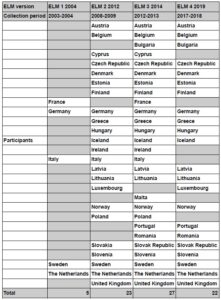
EFNIL has already conducted a one-year feasibility study to explore the possibility of language monitoring on a European scale. The countries that were covered by that limited study were France, Germany, Italy, the Netherlands, and Sweden, that is, five dominantly monolingual countries. A pilot monitor was successfully developed and can be viewed at www.europeanlanguagemonitor.org (user name: efnil, password: efnil). As a result of recent developments in the participating countries, part of the information given by the pilot monitor is outdated, which is one of the arguments for a monitoring system that will have to be updated at short intervals.
As mentioned, the ELM is not intended as a replacement for other European information services such as the Eurobarometer or Eurydice. While these surveys concentrate on (foreign) language learning, the ELM will provide detailed information on the use of the various languages in essential national and transnational domains at a given time and on how language use in these domains changes in the course of time. The ELM group of EFNIL will make contacts with these surveys to agree on a clear division of labour. Scope and details of the ELM should be comparable to those of the European Social Survey (ESS).
The member institutions of EFNIL are willing and prepared to cooperate in the sociolinguistic development of ELM and the collection of the data on the linguistic situation of their individual countries. However, the considerable costs of coordination, technical development, and permanent operation of the ELM cannot be financed from the limited budgets of the participating language planning and research institutions. Sufficient funding by the European Union is needed and will be applied for.
Coordinator: Ellen Fernhout (efernhout@taalunie.org)